

Boring Explanations for a Loud Market
The benchmark 30-year Treasury yield sits above 5%, long government bond yields across the developed world have reached multi-decade highs, and US federal debt crossed $40 trillion. These facts arrived close enough together to be treated as one, and much of the commentary treats them that way. The repricing is real all the same. Our experience urges some caution about the explanation, though.
Narratives we see would carry implications for intermediate bonds too: that the market has lost faith on inflation, that investors are charging up for profligate fiscal policy, or that US Treasuries are no longer viewed as safe. We are not economists, and we do not claim to know the meaning of every curve move or how it will move next, but we see little evidence that recent market moves can be ascribed to causes this severe.
Is the Market Pricing Runaway Inflation?
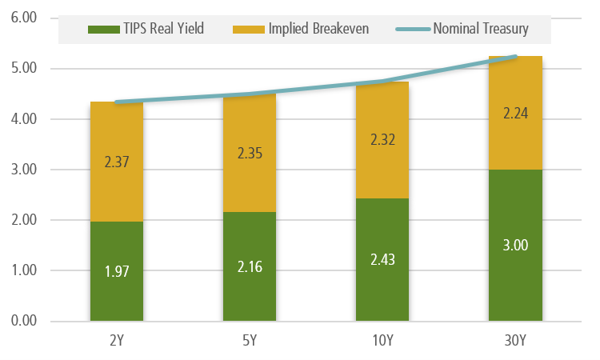
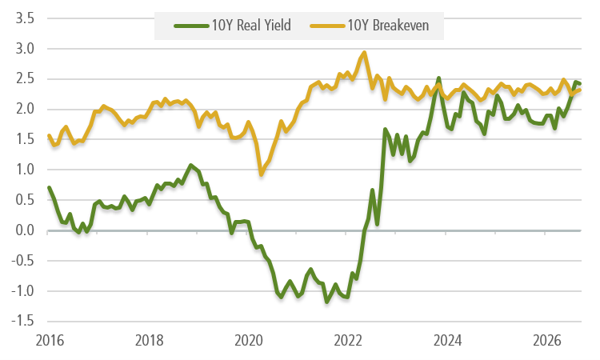
Starting with the cleanest of the three, the gap between nominal Treasury yields and inflation-protected TIPS gives a market-implied path of inflation. At the end of August, the path sat near 2.35% at five years and 2.24% at thirty, not far from where it has spent most of the past two decades. Those figures reference CPI, which has historically run a few tenths above the PCE measure the Fed targets. With oil near $90 and headline inflation well above those levels, the market is pricing the current energy shock to fade rather than persist. Investors are charging declining inflation compensation across the curve, which is not the shape of a market braced for persistent inflation.
Exhibit 1: What the market is charging, by maturity
Upper panel: nominal yield decomposed into real yield and implied breakeven, %, as of 8/31/26. Lower panel: 10-year real yield and breakeven over time.
Source: Bloomberg, JAG Capital Management
Interaction matters more here than levels. When nominal yields rise while inflation expectations hold steady, real yields are the driver. Investors are demanding more compensation for lending over long horizons. That is a different question from an inflation problem, and it has a different answer.
A Uniquely American Problem?
We do not dismiss the fiscal situation, but we are skeptical that it has much impact on daily or weekly curve moves. We see it as more of an inertia problem. Regardless, global markets are casting doubt upon the explanation that higher long-term yields are a uniquely American issue.
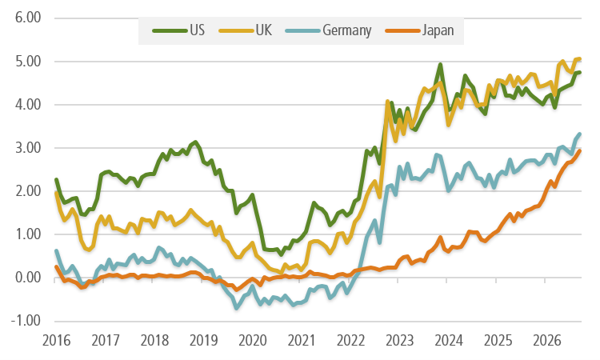
Ten-year government yields have risen across the United States, the United Kingdom, Germany, and Japan, in the same direction and over the same period. Germany’s ten-year recently touched its highest level since 2011, the United Kingdom’s its highest since 2008, and Japan’s a thirty-year high. These four governments share the global bond market, but they have different fiscal positions.
Exhibit 2: Same move, four governments
Ten-year government bond yields, %.
Japan illustrates why relative value is a fluid assessment. A Japanese investor who can now earn a meaningful yield at home has less reason to buy foreign bonds and accept currency risk or hedging costs. That weakens a source of demand for foreign paper that had been reliable for years. The marginal Japanese buyer of a thirty-year Treasury is a less certain participant than they were three years ago, but for arithmetic reasons rather than any judgement about deficit spending.
A Creditworthiness Problem?
We are left with the third explanation, which is complicated by its catch-all nature and interactions between the underlying issues. We have already observed that real yields are driving the curve higher—indeed a logical outcome of a US credit concern. The evidence against it sits in corporate bonds.
Spreads remain near the tight end of their historical range, with the fundamentals underpinning them intact (we made the broader case for owning credit at these levels in last year’s fourth-quarter Insight). The narrower point here is that a market worried about national growth, solvency, or a funding squeeze does not price corporate credit this way. US corporations, the dollar, and federal creditworthiness are inextricably linked.
The Cost of Capital
We offer one alternate explanation, simpler and more mundane, that can coexist with others. Demand for capital is high, and its price (i.e., investors’ yield or expected return) is broadly rising.
Treasury net issuance and investment-grade corporate issuance have both stepped up materially, the latter driven in part by the infrastructure buildout our colleagues on the equity team documented recently. Investment-grade supply has run near $1.4 trillion through August, ahead of the pace that produced the 2020 record. So far, the market has funded this buildout without much drama; new-issue concessions have been minimal. Record volume absorbed at tight spreads does not signal a funding problem.
None of which makes higher real yields costless. A higher real rate is a higher discount rate on every asset, a higher hurdle for levered borrowers, and a larger interest bill for a government whose debt keeps expanding.
The Bottom Line
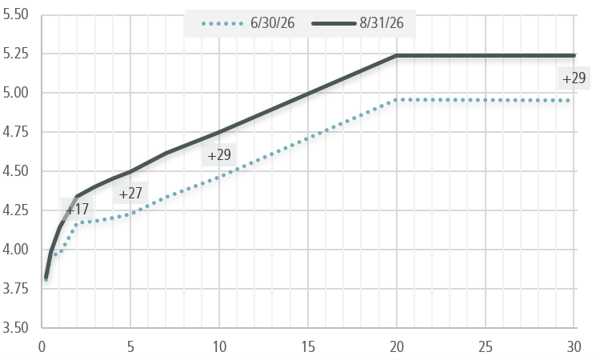
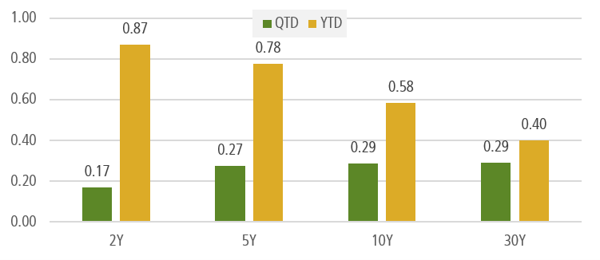
Thought experiments aside, our anchor has been the magnitude of the moves themselves. The move at the long end this quarter has been measured in tens of basis points rather than hundreds, it has been shared across four continents, inflation compensation sits roughly where it has sat for twenty years, and credit spreads remain near the tight end of their range. The commentary has traveled considerably further than the market has.
Exhibit 3: What actually moved
Upper panel: yield levels as of 8/31 and 6/30; Lower panel: change, quarter to date and year to date, as of 8/31.
Source: Bloomberg, JAG Capital Management
We have no special insight into where the thirty-year Treasury issue trades in December, and we do not spend much time on the question. What we would say is that the trajectory heading into August was a constructive one, and the reasons behind it are largely intact. Higher real yields ask more of borrowers and offer more to lenders. Intermediate bondholders are collecting a real yield that was unavailable for most of the past fifteen years, and we believe they are being paid to wait.
– JAG’s Fixed Income Research Team
Disclosures
These comments were prepared by the staff of JAG Capital Management, LLC, an SEC-registered investment adviser. The information herein was obtained from various sources including but not limited to FactSet, Bloomberg, Reuters, Standard & Poor’s, Epoch AI, ChatGPT, Claude, and the United States Bureau of Labor Statistics, and believed to be reliable; however, we do not guarantee its accuracy or completeness. The information in this report is given as of the date indicated. We assume no obligation to update this information, or to advise on further developments relating to securities discussed in this report. The opinions expressed are those of the adviser listed above as of the date of this report and are subject to change without notice. The opinions of individual representatives may not be those of the Firm. Additional information is available upon request.
The information contained in this document is prepared and circulated for general information only. It does not address specific investment objectives, or the financial situation and the particular needs of any recipient. Investors should not attempt to make investment decisions solely based on the information contained in this communication as it does not offer enough information to make such decisions and may not be suitable for your personal financial circumstances. You should consult with your financial professional prior to making such decisions. For institutional investors: JAG Capital Management, LLC, has a reasonable basis to believe that you are capable of evaluating investment risks independently, both in general and with regard to particular transactions or strategies. For institutions who disagree with this statement, please contact us immediately.
Past performance should not be considered indicative of future performance. Any investment contains risk including the risk of total loss.
This document does not constitute an offer, or an invitation to make an offer, to buy or sell any securities discussed herein. J.A. Glynn & Co., JAG Capital Management, LLC, and its affiliates, directors, officers, employees, employee benefit programs and discretionary client accounts may have a position in any securities listed herein.
About JAG
JAG Capital Management (JAG) actively invests for institutions and individuals in highly selective, customizable, and nimble equity and fixed income strategies. JAG is a boutique, independent, employee-owned investment management firm in St. Louis.