

Buying tends to get most of the attention in investing. However, developing a strong investment sell discipline can be just as important.
A disciplined sell process can help investors avoid emotional decisions, manage risk, and keep portfolios aligned with long-term objectives. Without that discipline, portfolios can gradually become crowded with outdated ideas, oversized positions, or holdings that no longer fit the original investment thesis.
We subscribe to the thinking that sell discipline is an important part of active portfolio management. The goal is to make thoughtful decisions when the facts change, risk increases, or a more compelling opportunity emerges. Rather than reacting to headlines or short-term price movement
What Sell Discipline Means
Sell discipline is a structured approach to deciding when an investment should be reduced or removed from a portfolio.
It helps answer a simple but important question:
Why do we still own this?
A strong investment process should not end after a security is purchased. Each holding should continue to earn its place in the portfolio. That means monitoring fundamentals, valuation, competitive position, balance sheet strength, earnings quality, risk exposure, and overall portfolio fit.
Sell discipline can help investors avoid two common mistakes. One is holding on too long because of emotion, hope, or attachment to a past winner. The other is selling too quickly because of short-term volatility or market noise.
A disciplined process helps separate temporary price movement from a meaningful change in the investment case.
Why Selling Is Hard
Selling can be difficult because investing involves both analysis and behavior.
Investors may become attached to a company that has performed well in the past. They may hesitate to sell a losing position because doing so feels like admitting a mistake. They may also hold an investment simply because it has been in the portfolio for a long time.
Those behavioral pressures can lead to decisions that are not fully aligned with the portfolio’s current objectives.
A stock that once fit the portfolio may become too expensive. A company’s fundamentals may weaken. A balance sheet may deteriorate. A competitive advantage may fade. A position may grow too large relative to the rest of the portfolio.
In those situations, continuing to hold an investment simply because it was once attractive can create unintended risk.
Sell discipline helps bring the conversation back to process.
Common Reasons to Sell
There is no single reason to sell an investment. The decision should depend on the strategy, the client’s objectives, and the role of the holding within the portfolio.
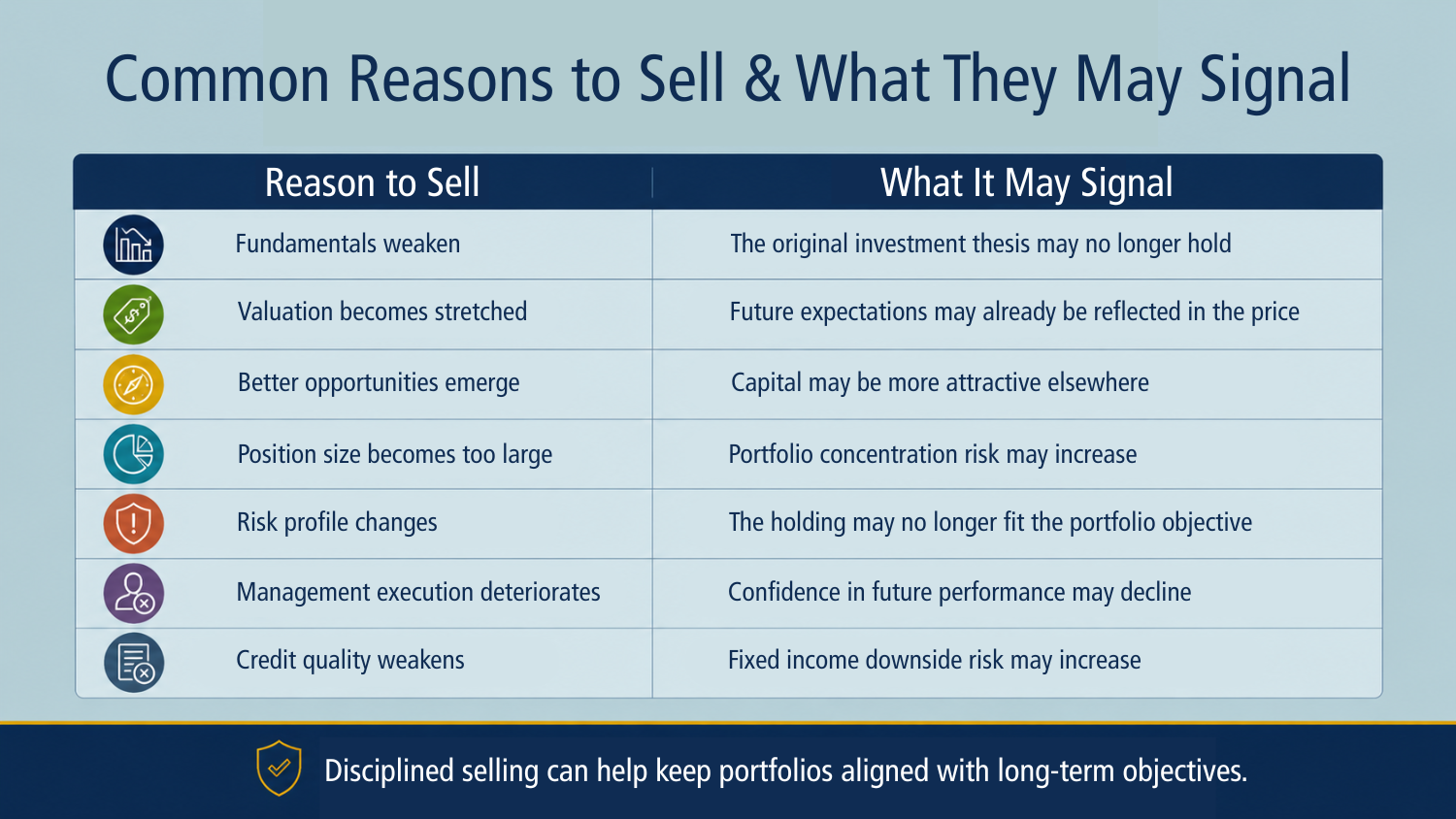
| Reason to Sell | What It May Signal |
|---|---|
| Fundamentals weaken | The original investment thesis may no longer hold |
| Valuation becomes stretched | Future expectations may already be reflected in the price |
| Better opportunities emerge | Capital may be more attractive elsewhere |
| Position size becomes too large | Portfolio concentration risk may increase |
| Risk profile changes | The holding may no longer fit the portfolio objective |
| Management execution deteriorates | Confidence in future performance may decline |
| Credit quality weakens | Fixed income downside risk may increase |
Selling does not always mean the original purchase was wrong. Markets change. Companies change. Valuations change. Client needs change.
A disciplined sell decision recognizes those changes and responds thoughtfully.
Sell Discipline in Equity Portfolios
In equity portfolios, sell discipline often begins with the investment thesis. Investors must ask themselves:
- Why was the company purchased?
- What growth drivers were expected?
- What valuation assumptions were reasonable?
- What risks were being accepted?
If the answers change materially, the holding may need to be reviewed.
A company may still be growing but no longer justify its valuation. Another company may have strong revenue growth but declining margins, weaker cash flow, or poor capital allocation. A business may remain high quality but become too large a position after a strong run.
Active equity management requires ongoing judgment. The question is not simply whether a company is good. The question is whether it remains an attractive investment at its current price, position size, and role within the portfolio.
Sell Discipline in Fixed Income Portfolios
Sell discipline also matters in fixed income.
Bond investors often focus on yield, but yield is only one part of the decision. Credit quality, duration, liquidity, maturity structure, and downside risk all matter.
A bond may need to be sold or reduced if the issuer’s credit profile weakens, if compensation for risk becomes less attractive, or if the position no longer fits the portfolio’s income and risk objectives.
In fixed income, investment sell discipline can be especially important because reaching for yield can expose investors to risks they may not fully intend to take. An active process helps evaluate whether the portfolio is being appropriately compensated for credit, interest rate, and liquidity risk.
Finding the Balance Between Patience and Action
Sell discipline does not mean constant trading. Short-term volatility is part of investing, and a temporary decline does not always mean the long-term investment case has changed.
At the same time, patience should not become inaction.
A holding may need to be reviewed if the original thesis weakens, valuation becomes difficult to justify, credit quality deteriorates, or the position grows too large relative to the rest of the portfolio. In those cases, continuing to hold simply because the investment once made sense can create unnecessary risk.
The key is understanding why a holding is under pressure. If the long-term thesis remains intact, patience may be appropriate. If the facts have changed, action may be required.
A disciplined sell process helps investors avoid both extremes: selling too quickly because of market noise and holding too long because of attachment, hope, or hesitation.
How Sell Discipline Supports Risk Management
Sell discipline is one of the practical ways investors manage risk.
It can help prevent portfolios from becoming overly concentrated in one company, sector, theme, or market environment. It can also help reduce exposure when valuation, fundamentals, or liquidity conditions become less attractive.
Risk management does not eliminate losses. No investment process can do that. But a thoughtful sell process can help make risk more visible, intentional, and aligned with the portfolio’s objectives.
That matters because investors do not experience risk only as numbers on a page. They experience it through drawdowns, volatility, income disruption, tax considerations, and the emotional pressure to make decisions at the wrong time.
A disciplined sell process can help reduce that pressure by creating a framework before stress arrives.
Key Takeaway
Sell discipline is an essential part of active portfolio management.
It helps investors review what they own, why they own it, and whether each holding still fits the portfolio’s objectives. It can also help manage concentration, reduce behavioral mistakes, and keep capital aligned with the portfolio’s long-term purpose.
Selling is not an afterthought in our investment process. We view it as part of the discipline that supports thoughtful decision-making and long-term client outcomes.