

Market volatility has become a recurring feature of modern investing. Periods of rapid price swings, shifting interest rates, and geopolitical uncertainty can create challenges for both investors and advisors.
In this environment, SMAs in volatile markets can offer several advantages compared with pooled investment vehicles. Separately managed accounts allow advisors and portfolio managers to adjust holdings at the individual account level, which can improve flexibility, tax efficiency, and overall portfolio customization.
For financial advisors working with clients during uncertain market periods, SMAs may provide tools that help maintain discipline while adapting to changing conditions.
What Are SMAs?
A separately managed account (SMA) is an investment portfolio of individual securities managed on behalf of a single investor. Unlike mutual funds or ETFs, the investor directly owns the underlying securities in the account.
Because the portfolio is managed at the account level, SMAs allow for a higher degree of customization. Portfolio managers can adjust based on the client’s investment objectives, tax considerations, and portfolio constraints.
This structure becomes particularly valuable when markets experience heightened volatility.
Flexibility During Volatile Markets
One of the primary advantages of SMAs in volatile markets is the flexibility they offer portfolio managers.
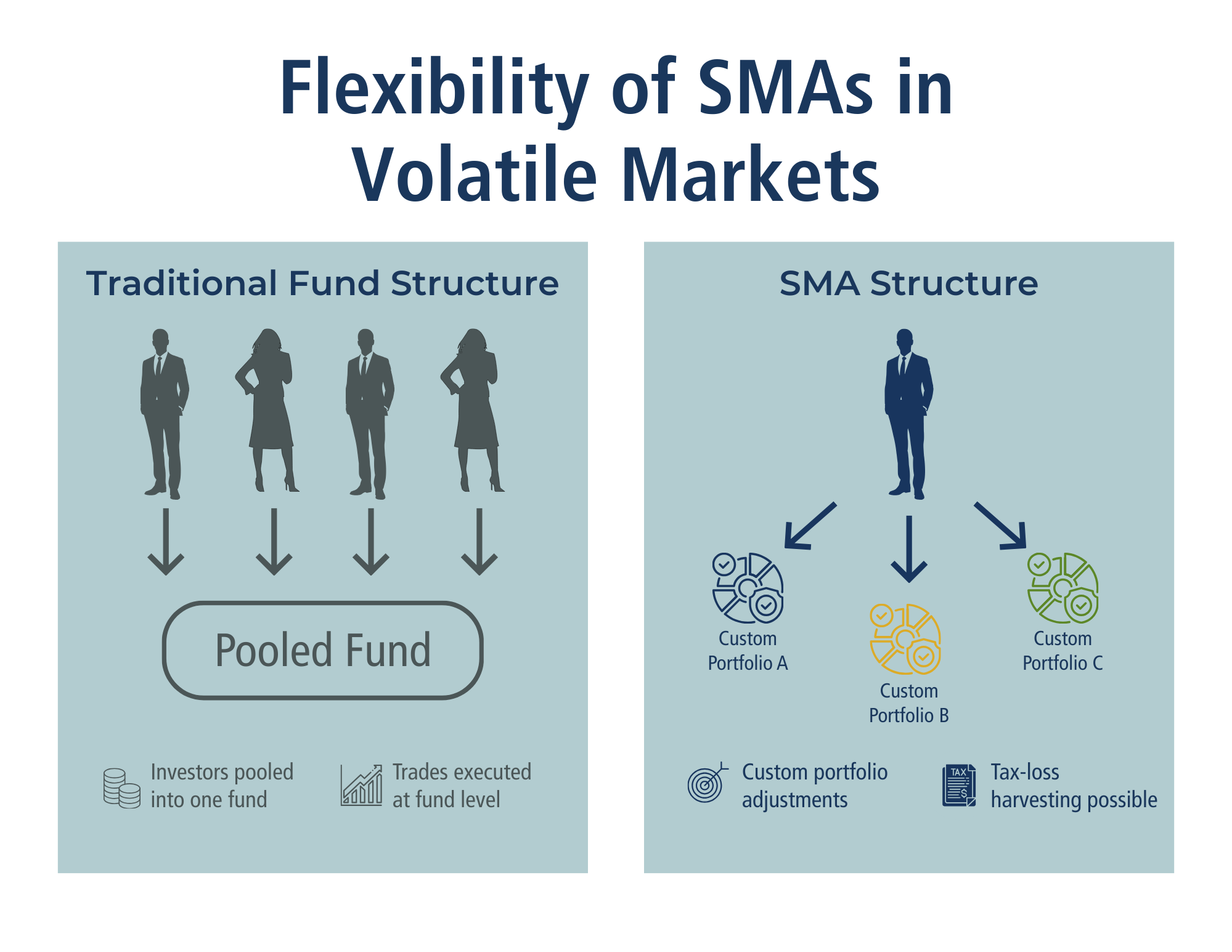
Pooled investment vehicles such as mutual funds must trade at the fund level, which means managers may need to buy or sell securities based on investor flows rather than purely on investment fundamentals.
Separately managed accounts operate differently. Portfolio decisions can be implemented at the individual account level, allowing managers to:
- Adjust position sizes when volatility increases
- Avoid unnecessary trades triggered by fund redemptions
- Maintain long-term holdings through short-term market disruptions
This flexibility can help reduce forced trading and allow portfolio managers to remain focused on long-term investment strategy rather than short-term market noise.
Tax-Loss Harvesting Opportunities
Volatile markets often create opportunities for tax-loss harvesting, and SMAs can make this process more precise.
Because investors directly own the individual securities in a separately managed account, portfolio managers can realize losses on specific holdings while maintaining exposure to the broader market.
This can potentially allow investors to:
- Offset realized capital gains
- Reduce taxable income in certain circumstances
- Reinvest proceeds in similar securities to maintain market exposure
Tax-loss harvesting is not always possible within pooled investment vehicles, where gains and losses are managed at the fund level.
For advisors working with taxable clients, the ability to implement tax strategies within SMAs in volatile markets can be a meaningful advantage.
Rebalancing at the Account Level
Market volatility can cause portfolio allocations to drift away from their intended targets. Over time, these shifts may expose clients to unintended levels of risk.
SMAs allow portfolio managers to rebalance portfolios at the individual account level, which can help maintain alignment with a client’s strategic asset allocation.
For example, during periods when equity markets decline sharply, portfolio managers may selectively rebalance positions to restore target allocations while also considering tax implications and portfolio constraints.
This level of control can help advisors maintain portfolio discipline even during periods of significant market stress.
Behavioral Advantages for Clients
Volatility often introduces behavioral challenges for investors. Rapid market declines can increase the temptation to make emotionally driven decisions, such as selling during downturns or abandoning long-term strategies.
(Our CEO, Norm Conely, addresses this in his book The Art of Investment Misery.)
SMAs can help advisors address these behavioral risks in several ways.
First, transparency within separately managed accounts allows clients to see the individual holdings in their portfolios. This visibility can reinforce the long-term investment strategy and provide a clearer understanding of how the portfolio is positioned.
Second, the customized nature of SMAs allows advisors to tailor portfolios to each client’s risk tolerance and financial goals. When clients feel their portfolio reflects their personal circumstances, they may be more likely to remain disciplined during market fluctuations.
Finally, active communication around portfolio adjustments and tax strategies can help reinforce confidence during uncertain market environments.
Integrating SMAs Into Portfolio Construction
For financial advisors, SMAs can serve as a flexible building block within a broader portfolio framework.
In many cases, advisors combine SMAs with other investment vehicles to achieve diversification across asset classes, strategies, and market segments. This approach allows advisors to maintain customization where it matters most while still benefiting from broader market exposure.
Understanding how SMAs in volatile markets interact with other portfolio components can help advisors design investment strategies aligned with each client’s long-term objectives.
Advisors may also consider how SMAs fit alongside other portfolio approaches discussed in our article on fund management strategies.
Final Thoughts
Market volatility is an inevitable part of long-term investing. While short-term market movements can create uncertainty, they can also highlight the importance of flexibility, discipline, and thoughtful portfolio management.
For financial advisors, SMAs in volatile markets offer several potential benefits, including:
- Greater portfolio flexibility
- Targeted tax-loss harvesting opportunities
- Rebalancing at the individual account level
- Behavioral support for clients during market stress
By combining customization with , separately managed accounts may help advisors navigate challenging market environments while keeping clients focused on long-term financial goals.