

Liquidity is one of the most important, and often underappreciated, drivers of portfolio resilience in institutional investing. Institutional portfolio liquidity management plays a vital role in maintaining that resilience.
For many institutions, that challenge has become more visible in recent years as allocations to private markets have grown, distributions have slowed, and portfolio weights have shifted during periods of market stress. What was once a background consideration has moved closer to the center of portfolio decision-making.
At its core, this is a liquidity management problem. Institutions are not just allocating capital, they are managing how and when capital moves across the portfolio. That includes funding obligations, meeting spending needs, rebalancing exposures, and maintaining flexibility in uncertain environments.
In that context, liquidity is not simply a constraint. It is a strategic asset.
Liquidity and Portfolio Construction
From a total portfolio perspective, liquidity risk does not exist in isolation. It emerges from the interaction between different asset classes, funding needs, and market conditions.
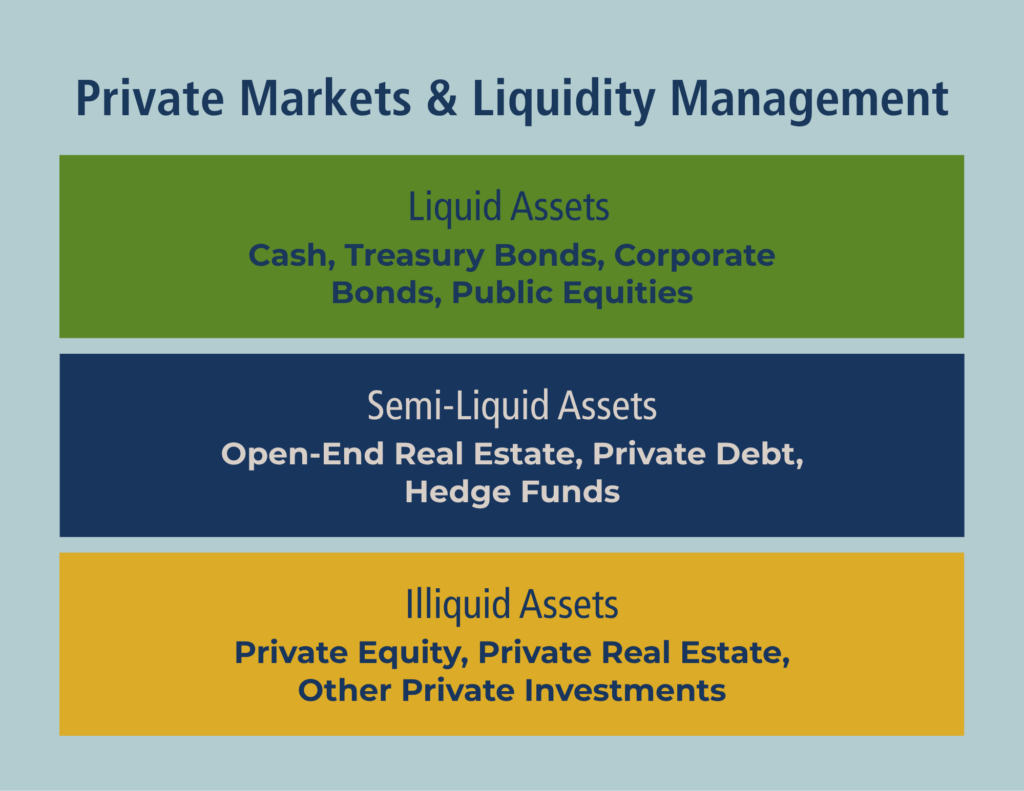
Liquid assets, such as public equities and fixed income, provide flexibility. They allow institutions to rebalance, meet obligations, and respond to changing conditions without disrupting long-term strategy. Illiquid assets, including private investments, can enhance returns and diversification, but they reduce that flexibility.
Neither is inherently better. The challenge is how they fit together.
A well-constructed portfolio balances these characteristics. It ensures that the pursuit of long-term return does not come at the expense of short-term flexibility, particularly during periods when liquidity is most valuable. For this reason, institutional portfolio liquidity management is critical in balancing the conflicting demands of liquid and illiquid assets.
Cash Flow Management and Portfolio Stability
Cash flow is the mechanism through which liquidity risk becomes real.
Institutions must continuously manage inflows and outflows- spending, capital calls, rebalancing activity, and distributions. These flows are rarely smooth or predictable. In periods where inflows slow or outflows accelerate, liquidity pressure can build quickly.
This dynamic is especially relevant for portfolios that include illiquid investments. Capital may be committed years in advance, deployed over time, and returned unevenly. When distributions slow, institutions may need to fund obligations from other parts of the portfolio.
That is why liquidity planning should be built around variability, not precision. The goal is not to forecast cash flows perfectly, but to ensure the portfolio can absorb uncertainty without forcing reactive decisions.
Commitment Pacing as a Portfolio Lever
When liquidity conditions tighten, institutions have relatively few levers they can adjust in real time. Commitment pacing is one of them.
Rather than viewing pacing as an isolated private markets decision, it is more useful to think of it as a portfolio-level tool. It influences future capital calls, expected distributions, and the evolution of portfolio exposures over time.
A disciplined pacing framework helps institutions maintain alignment between long-term targets and real-world liquidity constraints. It also reduces the likelihood of overcorrecting during periods of stress, such as pausing commitments entirely or concentrating exposure in a narrow set of vintages.
Consistency, in this context, is not about rigidity. It is about maintaining direction through changing conditions.
The Denominator Effect and Market-Driven Liquidity Risk
One of the clearest examples of how liquidity risk emerges at the portfolio level is the denominator effect.
When public markets decline, total portfolio value can fall quickly. Private asset valuations, however, often adjust more slowly. The result is a mechanical increase in the relative weight of illiquid assets, even if no new capital has been committed.
This shift can create both real and perceived pressure. Allocations may move above policy targets, governance constraints may tighten, and institutions may feel compelled to reduce or pause new commitments.
Importantly, this dynamic is driven by movements in liquid markets. It is not a function of private market fundamentals alone.
That is why managing the denominator effect requires a total portfolio perspective. Institutions that anticipate this interaction by maintaining liquidity buffers, building flexibility into policy ranges, and stress testing portfolio outcomes are better positioned to respond without disrupting long-term strategy.
Private Markets as Part of a Broader Liquidity Framework
Private markets can play an important role in long-term institutional portfolios. They offer access to differentiated return streams and can enhance diversification over time.
At the same time, their inclusion increases the importance of disciplined liquidity management.
Illiquid investments introduce timing uncertainty. Capital is called gradually, distributions are unpredictable, and portfolio weights can shift during periods of market volatility. These characteristics do not make private markets less valuable, but they do make the overall portfolio more complex to manage. In fact, effective institutional portfolio liquidity management helps navigate these complexities.
The key is not to evaluate private markets in isolation, but to understand how they interact with the rest of the portfolio, particularly with liquid assets that serve as the primary source of flexibility.
Liquidity Management and Portfolio Alignment
Effective liquidity management requires aligning portfolio structure with real-world demands.
That includes:
- Spending requirements
- Capital commitments
- Rebalancing needs
- Potential stress scenarios
A portfolio that appears well-balanced under normal conditions may behave very differently when multiple pressures emerge simultaneously. Slower distributions, declining public markets, and ongoing obligations can combine to create meaningful strain.
This is where structure matters most. The size of illiquid allocations, the pacing of commitments, the diversification of exposures, and the availability of liquid assets all influence how resilient the portfolio will be.
Liquidity, in this sense, is not just about meeting near-term needs. It is about preserving the ability to make decisions on your own terms.
Pacing, Liquidity, and Long-Term Discipline
The institutions that navigate these challenges most effectively treat liquidity as a core component of strategy, not as a secondary consideration. Above all, strong institutional portfolio liquidity management ensures both flexibility and resilience.
They tend to:
- Align commitments with long-term exposure targets and liquidity capacity
- Stress test portfolios for slower distributions and market drawdowns
- Maintain liquidity buffers beyond baseline expectations
- Commit consistently across market cycles while preserving flexibility
These practices do not eliminate uncertainty. They allow institutions to operate through it.
Conclusion
Liquidity risk rarely emerges from a single decision or asset class. It reflects how the entire portfolio behaves under changing conditions.
As allocations evolve and market environments shift, the interaction between liquid and illiquid assets becomes increasingly important. Managing that interaction effectively is what allows institutions to remain flexible, avoid forced decisions, and stay aligned with long-term objectives.
In that sense, liquidity is not just a constraint on portfolio construction, it is a defining feature of it.