

Do I need a financial advisor? It’s a question many retail investors ask, especially in a world where investing has never been more accessible.
With low-cost platforms, index funds, and endless financial content, it’s easy to believe you can manage everything on your own. And technically, you can. But the better question is this: Are you making the most informed and strategic decisions possible?
Because investing is only one part of your financial life. A financial advisor helps bring the rest into focus.
What Does a Financial Advisor Actually Do?
When people ask, “Do I need a financial advisor?” they often think of stock picking or portfolio management. In reality, that’s only a small part of the value.
A financial advisor helps you:
- Build a comprehensive financial plan
- Align your investments with long-term goals
- Reduce tax inefficiencies
- Plan for retirement income
- Navigate major life events
In other words, an advisor connects the dots, not just your investments.
Do I Need an Advisor If I Can Invest on My Own?
Many retail investors today take a DIY approach. If you’re disciplined, consistent, and focused on long-term investing, you may feel confident managing your portfolio.
However, managing investments alone doesn’t always mean you’re optimizing your financial life.
For example:
- Are you minimizing taxes across different accounts?
- Do you have a clear strategy for withdrawals in retirement?
- Is your portfolio aligned with your broader financial goals?
These are the areas where even capable investors can fall short. As a result, the question “Do I need a financial advisor?” becomes less about ability and more about optimization.
When Do You Need a Financial Advisor?
While every situation is different, there are clear moments when working with a financial advisor becomes especially valuable.
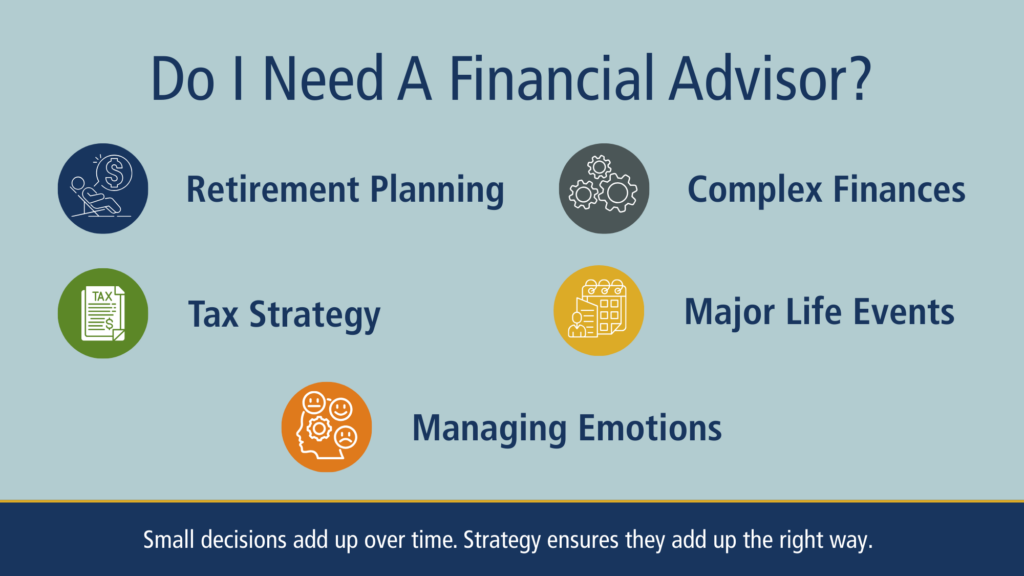
You may need a financial advisor if:
- Your financial life is becoming more complex
- You’re approaching retirement and need an income strategy
- You’ve experienced a major life event (sale of a business, inheritance, career change)
- You’re unsure how to manage taxes efficiently
- You find yourself reacting emotionally to market volatility
At these stages, financial decisions carry more weight and mistakes can be more costly.
The Cost of Not Having a Financial Advisor
One of the biggest concerns investors have is cost. Financial advisors typically charge a fee, whether it’s a percentage of assets or a flat rate.
But focusing only on fees can miss the bigger picture.
The real cost to consider is what happens without guidance:
- Missed tax-saving opportunities
- Inefficient withdrawal strategies
- Lack of coordination across financial decisions
- Emotion-driven investment mistakes
Over time, these gaps can have a meaningful impact on your overall financial outcome.
How Early Should I Engage an Advisor?
A common misconception is that you only need a financial advisor once you’ve built significant wealth.
In reality, working with an advisor earlier can help you:
- Avoid costly mistakes
- Build a more intentional strategy
- Create better financial habits
- Take advantage of long-term planning opportunities
The earlier you introduce structure, the more time it has to work in your favor.
A Better Way to Think About Financial Advice
So, do you need a financial advisor?
If your goal is simply to invest, you may be able to do that on your own. But if your goal is to optimize your entire financial life, the value of professional guidance becomes much clearer.
A financial advisor doesn’t take control away from you. Instead, they provide:
- Perspective
- Structure
- Accountability
Ultimately, they help you make better decisions over time.
Final Thoughts: Do I Need a Financial Advisor?
Coming back to the original question, “Do I need a financial advisor?”
For many retail investors, the answer is yes. Not because they can’t manage their money, but because they want to manage it more effectively.
The difference between doing it yourself and doing it strategically can be significant. And in many cases, that difference comes down to having the right guidance in place.