

Understanding the difference between small cap vs mid cap vs large cap stocks is an important part of building a diversified investment portfolio. These categories reflect the size of a company and often influence its growth potential, volatility, and overall risk profile.
Market capitalization, commonly called market cap, represents the total value of a company’s outstanding shares. Investors use market cap classifications to better understand how different types of companies may behave within an investment portfolio.
Each category- small cap, mid cap, and large cap- can play a different role in long-term investing.
What Is Market Capitalization?
Market capitalization is calculated by multiplying a company’s current share price by the total number of shares outstanding.
For example, if a company has 100 million shares trading at $50 each, its market capitalization would be $5 billion. That company would typically fall into the mid cap category.
Investors often evaluate companies based on three primary market cap groups:
- Small cap
- Mid cap
- Large cap
Understanding small cap vs mid cap vs large cap stocks can help investors evaluate growth opportunities and potential risks.
Small Cap Stocks: Higher Growth Potential
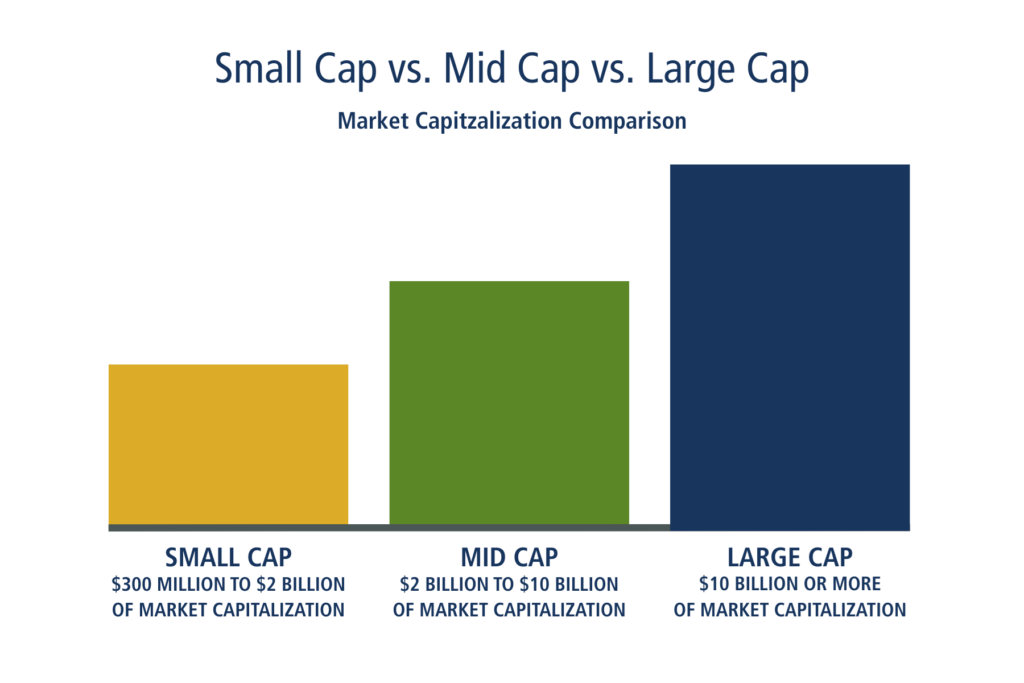
Small cap companies generally have market capitalizations between $300 million and $2 billion. These businesses are often earlier in their growth cycle and may still be expanding their products, operations, or market reach.
Potential advantages
Small cap stocks may offer higher growth potential because they are still developing their business models and expanding into new markets. Successful growth can have a significant impact on the company’s value.
Risks to consider
Small cap stocks are typically more volatile than larger companies. They may have fewer financial resources, less diversified revenue streams, and greater sensitivity to economic changes.
For this reason, small cap investments are often considered as part of a diversified portfolio rather than a concentrated position.
Mid Cap Stocks: A Balance Between Growth and Stability
Mid cap companies typically have market capitalizations between $2 billion and $10 billion. These businesses often represent firms that have already established successful operations but still have meaningful room for growth.
Potential advantages
Mid cap stocks may offer a balance between the growth potential of smaller companies and the stability of larger firms. Some mid cap companies eventually grow into large cap businesses as they expand.
Risks to consider
Mid cap stocks can still experience volatility, particularly during periods of economic uncertainty. Their performance may depend heavily on industry conditions and competitive pressures.
Large Cap Stocks: Stability and Established Businesses
Large cap companies generally have market capitalizations of $10 billion or more. These firms are typically well-established businesses with extensive operating histories and diversified revenue sources.
Potential advantages
Large cap companies often provide greater stability compared with smaller firms. Many have strong financial resources, experienced leadership teams, and established market positions.
Some large cap stocks also pay dividends, which can provide an additional source of return for investors.
Limitations
Because large cap companies are already well established, their growth rates may be slower than those of smaller firms.
However, their size and financial strength can help them remain more resilient during periods of market volatility.
Why Market Cap Diversification Matters
Diversifying across small cap vs mid cap vs large cap investments can help balance growth potential with stability.
Different market cap segments often perform differently across economic cycles. For example:
- Smaller companies may perform well during periods of economic expansion
- Larger companies may provide stability during market uncertainty
- Mid cap companies may offer a combination of both characteristics
Diversification does not eliminate risk, but it can help reduce the impact of volatility within a portfolio.
Investors often consider market cap diversification alongside other portfolio strategies, such as fund management strategies and broader asset allocation decisions.
How Market Cap Exposure Fits Into a Long-Term Strategy
The appropriate allocation between small cap vs mid cap vs large cap stocks depends on several factors, including:
- Investment time horizon
- Risk tolerance
- Financial goals
- Income needs
- Overall asset allocation
Investors with longer time horizons may choose to allocate more toward growth-oriented investments, while those prioritizing stability may emphasize larger companies.
There is no single allocation that works for every investor. Investment decisions should always reflect individual circumstances and long-term objectives.
Final Thoughts
Understanding the differences between small cap vs mid cap vs large cap stocks can help investors make more informed decisions about portfolio diversification.
Each category offers distinct characteristics:
- Small caps may offer higher growth potential with greater volatility
- Mid caps may balance growth and stability
- Large caps may provide stability and established market leadership
A diversified portfolio that includes exposure across market capitalizations may help investors pursue long-term financial goals while managing risk.
If you would like help evaluating your portfolio or developing a long-term investment strategy, contact us here.